
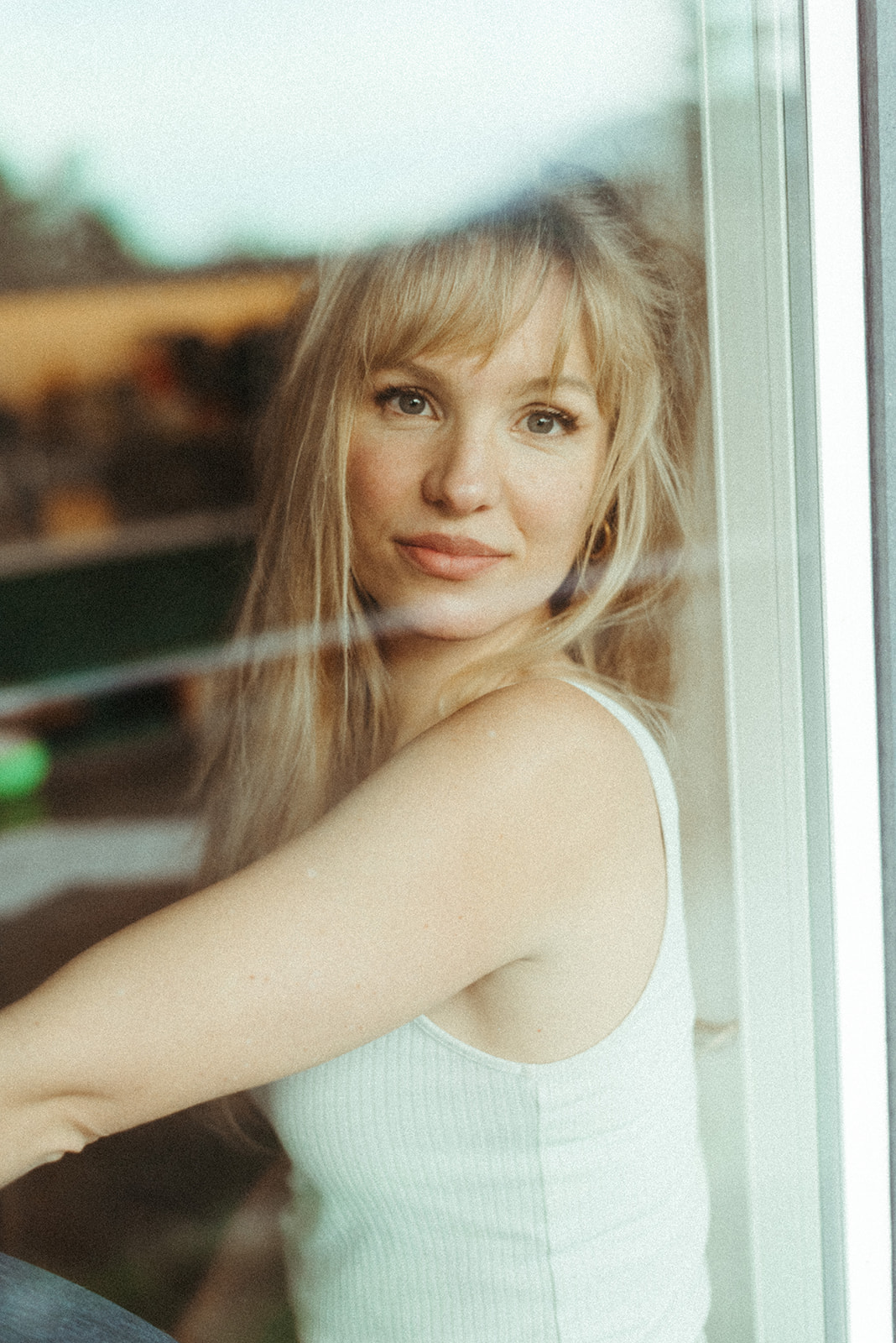
Canadian actress Debs Howard is a stellar talent whose star is steadily rising. A multi-nominated performer, including a 2025 UBCP/ACTRA Award nomination for Best Supporting Actress, (Movie of the Week), a Leo Award nomination for Best Lead Performance in a Motion Picture and a FilmQuest nomination for Best Supporting Actress, it is safe to say that Debs is only getting started. With a stand out performance as Marsha in Die My Love, we are confidently predicting even more fantastic roles for Debs. We caught up with her to discuss her journey so far:
Debs, huge congratulations on Die My Love and thank you for your time. The film exists within a space of really heightened emotional volatility and tension – how did you meet this tone without veering into melodrama?
Thank you so much! It’s been such an absolute pleasure to be a part of this. Die My Love is so poetically written and produced, that capturing the tone as an actor is all about just trusting in the material and the direction that you’re given. When the content is already fairly ‘heavy’, I don’t think you really need to put anything more on top of that, in terms of a performance. Great writing speaks for itself, so I really just let the script do the heavy lifting, and approached my part of the work with curiosity and empathy.
The film navigates themes of domestic claustrophobia and postpartum depression – why do you think these issues are so important to be explored, and how does Die My Love do so in such a heightened manner?
Well, I can say from my own personal experience, that motherhood – especially with a new baby – can feel incredibly isolating. As much as it is filled with pure love and wonder, it can also breed a lot of self-doubt and bitterness. And I really believe that a film like this, or a piece of art, that can shed light on the darkest parts of the human experience can make others feel seen and understood, in a way they hadn’t before. It sends the message that ‘you are not alone’. I think this can be triggering and uncomfortable for a lot of people, but is so important for humanity to understand the experiences of others, so that we can gain empathy and form community, especially in times like we have now. I love how the film was made in such a poetic way, so true to Lynne Ramsay’s style, with so much symbolism. People were able to interpret so much of it in different ways, which sparked such interesting conversation. Mental health issues, to me, often feel abstract to explain. I think it very fitting that a piece of cinematic art that dives into that world also lives in the figurative, and is not expository.
What originally drew you to the script, and did you choose to read the novel in preparation for the role?
I remember that when I first read the script, I was sobbing, as I realized how so much of Grace’s (Jennifer Lawrence’s character) actions were a physical manifestation of how I have felt within motherhood. Certain feelings or experiences you can’t put in to words, but feel uncomfortably familiar when you see them. It was like that for me, visualizing the story as I read the script. I did read the novel, and was very moved by it, in much the same way as I was the script. I think part of my job as an actor is to do as much homework as possible to prepare, and then to trust myself enough to let it all go between the moments of ‘Action’ and ‘Cut’.
How did your own experiences with motherhood impact your relationship to the story?
It made it all so visceral! As much as motherhood has expanded my range of emotions, between the good, the bad, and the ugly, it also allowed me to experience empathy among the different characters in this story on a much more cellular level.
Was there any subtext with your character that you chose particularly to focus your performance around?
I really try to relate to, and be able to advocate for, my characters. I approached my character Marsha with a lot of empathy. I try to see as much of myself within a character as possible, even if they may look quite different on the surface. So even though Marsha presents as a woman who is quite put together, I wanted to give her a messy human experience and backstory as well. In the beginning of the scene, I chose to play Marsha in the way that she actually really wanted to connect with Grace because she saw some of herself in Grace (just as I do!) Grace physically looks the way Marsha has felt so many times, so the subtext I chose to play was to have her genuinely offer her hand out to Grace. Maybe Marsha has a bit of a hero complex, and maybe I do too… (don’t worry, I’ll unpack that in therapy), but when Grace shifts the energy and manipulates the conversation, I wanted Marsha to stand her ground. The result ended up being sort of a shifting power dynamic between the two characters, which was so much fun to play.
How would you describe your experience of working with Lynne Ramsey? What kind of environment does she cultivate on set, and how has it differed from other projects that you’ve been involved in?
First of all, Lynne is a legend. Not just because she is so incredibly warm, humble, and welcoming, but also because she is a true artist, making bold choices in her work that leads us all into unexpected but authentic places within ourselves. I was so honoured and grateful to have the opportunity to work with her. She is very clear on her vision, but also loves to collaborate, so she sort of lays out the parameters and then sets you free within them. You can see that she trusts in herself, but also trusts in the people around her. It felt very much like a team environment, where no one person on set was more essential than another to bring the story to life. It was different from other projects for me just in the way that it felt like we were creating something that was bigger than ourselves. I’ve been fortunate to have felt that sort of collaborative team atmosphere on previous sets, but there was something about this one that just felt a little bit magical in a way that I hadn’t experienced before.
Tell us about the film’s premiere at Cannes – how does it feel to be part of a project premiering at the festival and that is nominated for the Palme d’Or?
My entire time in Cannes was honestly a dream come true. Acting is really all I’ve ever wanted to do for a career, but I don’t think I ever had “walking the red carpet at Cannes Film Festival” on my bingo card! I felt so lucky and so grateful. And to be a part of a project that was nominated for the Palme d’Or really made me see that other people were just as impacted by this story and this journey as I was reading the script. Parenthood, not just motherhood, is an experience shared by so many of us, and in a world where people are often showcasing the best of themselves online, it’s important to remember that we all still go through the mud together too. Being in Cannes really solidified for me that being an actor in this wild industry is exactly what I want to do, and where I want to be, however volatile it may feel at times!
What was your immediate impression of the film after seeing the final cut for the first time? What do you hope has resonated with audiences, a few months on from the film’s release?
I think I was mostly in awe as I watched the credits roll in that theatre. The final cut was different than the original script in certain ways, and the way it turned out was so much more poetic than I had anticipated. In some respects, you’re left with more questions than answers, and I actually loved that. There are not a lot of films that I’ve seen recently that invoke such powerful emotions and spark such vulnerable conversation as this one did for me. What I ultimately hope people gain from this film, is to know that even in their darkest times, they are not alone. There are other people who will be able to relate, and hopefully, that can give people the strength to begin some hard discussions that will ultimately lead to more healing.
Your career has spanned such an impressive range of roles. How does your acting process evolve between comedies like The Honeymoon Pact and The Proposal Spot, to intense dramatic roles like Die My Love?
A lot of my process is dependent on collaboration. I make sure that I understand the story and the character on the page, but I don’t stay married to any of my choices. Once I’ve done my homework, I try my best to absorb the energy and information I’m getting from everyone else involved in the project, and make adjustments from there. I love being challenged by transitioning between different genres and roles. I want to experience the broadest range possible of performance, just as I want to understand a broad range of the human experience. A comfort zone is comfortable, but the learning and the real ‘fun’ for me is when I step outside of it. So my hope is to never get too comfortable within any type of genre or role.
Is there another genre or thematic interest that you would like to explore in future?
I would absolutely love to be a part of a sitcom. That sort of comedy and pacing has always appealed to me, and I’ve yet to step into that world. Here’s hoping!
Follow Debs on Instagram @debshoward


