

Ahluwalia’s Fall 2024 ‘Reveries’ Collection Celebrates Nigerian and Indian Folklore
By Allya-Brunnel Mormont
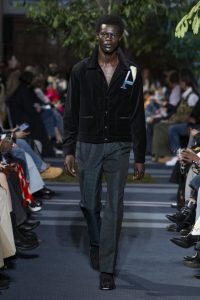
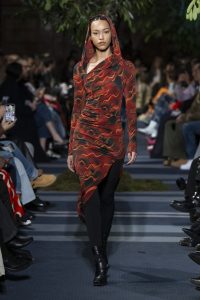
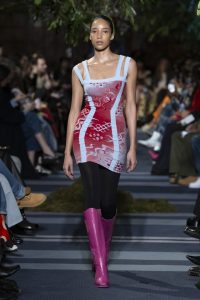
Ahluwalia closed London Fashion Week with a magnificent collection inspired by the fairy tales the designer heard as a child. Influenced by her Nigerian and Indian heritage, Ahluwalia has consistently created a temporal and spatial contention in each collection, emphasised by re-imagining her heritage in applying innovative textile and patchwork techniques to revitalise dead stock. As seen in her sophomore collection, Foundation A/W19, which repurposed dead stock into trendy geometric sports and casual wear, Reveries A/W24 takes sustainable fashion further into the realm of fantastical storytelling.
Ahluwalia is one of the newer brands taking over British fashion, only launching in 2018 by the Westminster University alumna, Priya Ahluwalia. The turn of the decade marked a bittersweet entrance for black game changers in British fashion and overseas. It was initially an exciting and promising time as the fashion industry pledged more diversity, bearing witness to supermodel Alton Mason being the first black male model to walk for Chanel and the British Vogue December issue with Adut Akech on the cover with exclusive interviews from the prominent black voices of Chimamanda Ngozi Adichie, Adwoa Aboah and Naomi Campbell.
Unfortunately, the political climate didn’t complement this sudden burst of acceptance. Alongside Trump’s presidency in the US, the turbulent Conservative government was embroiled in controversy for their mishandling of the Windrush scandal, which saw Black British People from the Commonwealth wrongly detained and even deported; the exposé of Boris Johnson’s racist depiction of African people and the British media taunting and bullying the American actress, and now Duchess of Sussex, Meghan Markle. It is this history that coincides with Ahluwalia’s work standing out as a breath-taking rebellion against racism in Britain.
Ahluwalia doesn’t shy away from speaking out against racism. Her last collection was purposely held at the British museum to highlight the stories of untold and forgotten, talented women of colour. She states to Vogue’s Sarah Mower, “Whatever I do, I think it’s all about, ‘Does this project sit in my values of telling untold stories, celebrating cultural histories, and thinking about making people and the planet better?’” These words echo that of the American academic and writer, Saidiya Hartman, and her critical fabulation theory which proposes storytelling as a function to represent the lives of forgotten people of colour in history.
Thus, Ahluwalia’s narrow use of critical fabulation presents a conflict in the way she views legacy compared to the western interpretation. The Western philosophy of legacy is the physical manifestation of archives: the hosting of exhibitions and the funding of British museums harbouring the preserved fashion of beloved European eras and the display of stolen artifacts pillaged from former colonies, the British Museum being a prime contributor of this. In the state of loss and obsolescence, naturally black artists must re-imagine the contours of legacy by cultivating the realm of fiction. This is what Kodwo Eshun calls ‘counter memory’. Part of ‘counter memory’ is to impose Jean Epstein’s ‘past-future’ vector, where time and space become interchangeable; the past transforms in the present, immortalising black art of the past in a different time frame and space. Thus, there is a focus on empire and re-imagining colonised people and culture without overt violence yet not purposely ignoring colonial history.
Saidiya Hartman theorises that one way to contribute to counter memory is through critical fabulation. Indeed, a fabula or fable is a folk tale oftentimes that comes with a critical lesson of life; a moral story that will guide generations. Most designers will use fashion as a vehicle to tell a fable to contribute to their own philosophy. However, Ahluwalia goes a step further to decolonise fiction and fantasy. In Reveries, she physically manifests Nigerian and Indian fairy tales that were usually told orally.
In the colonial era, the onus for the preservation of these stories is on the messenger. This collection seemingly relieves people – whom time is not their friend – of this responsibility as now a physical copy remains. Nonetheless, these pieces will withstand the power of death anyway. This collection was a collaboration with the iconic American brand, Levi’s, which upcycles their vintage denim, transforming them into lasered diamond prints and a sea of geometric patterns, respectively.
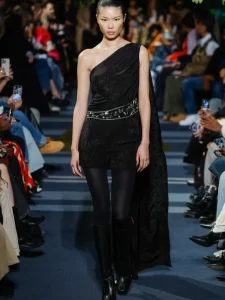
The fictional element is emulated in the silver sequins intricately placed on gowns draped on the models in the style of 18th Century saris, symbolising minute fairies. Symbolism is at the heart of this ethereal, cultural mesh, with cosmological prints of the moon as well as the natural imagery of land and sea articulated through the splash of blue, brown, green and red. In true Ahluwalia fashion, she reproduces the legendary Louis Vuitton chequered print, replacing the iconic LV logo with her own rendition of interlocking chains creating a jagged pathway across a blue shirt. She has always been vibrant and flamboyant in the way she envisions sartorial, masculine elegance, reminiscent of les Sapeurs of Congo – fashion innovators who reconceived European fashion to showcase pride in their appearance and social mobility. In this way, Reveries is quintessentially highlighting what it means to be of hybrid identities in a multicultural British society that still has an arduous journey towards racial equality.
In the words of Astruc, Ahluwalia uses her needle like a writer uses their pen. A staunch historian, she researches her cultural heritage with the sensitivity and focus to breathe life into an obsolete past. Like a Goddess, she resurrects the dead and offers them the eternal bliss of an afterlife in the stitches of her designs.


